> ## Documentation Index
> Fetch the complete documentation index at: https://docs.lekalao.com/llms.txt
> Use this file to discover all available pages before exploring further.
# Activity log
> Who did what in the team, to what, from where.
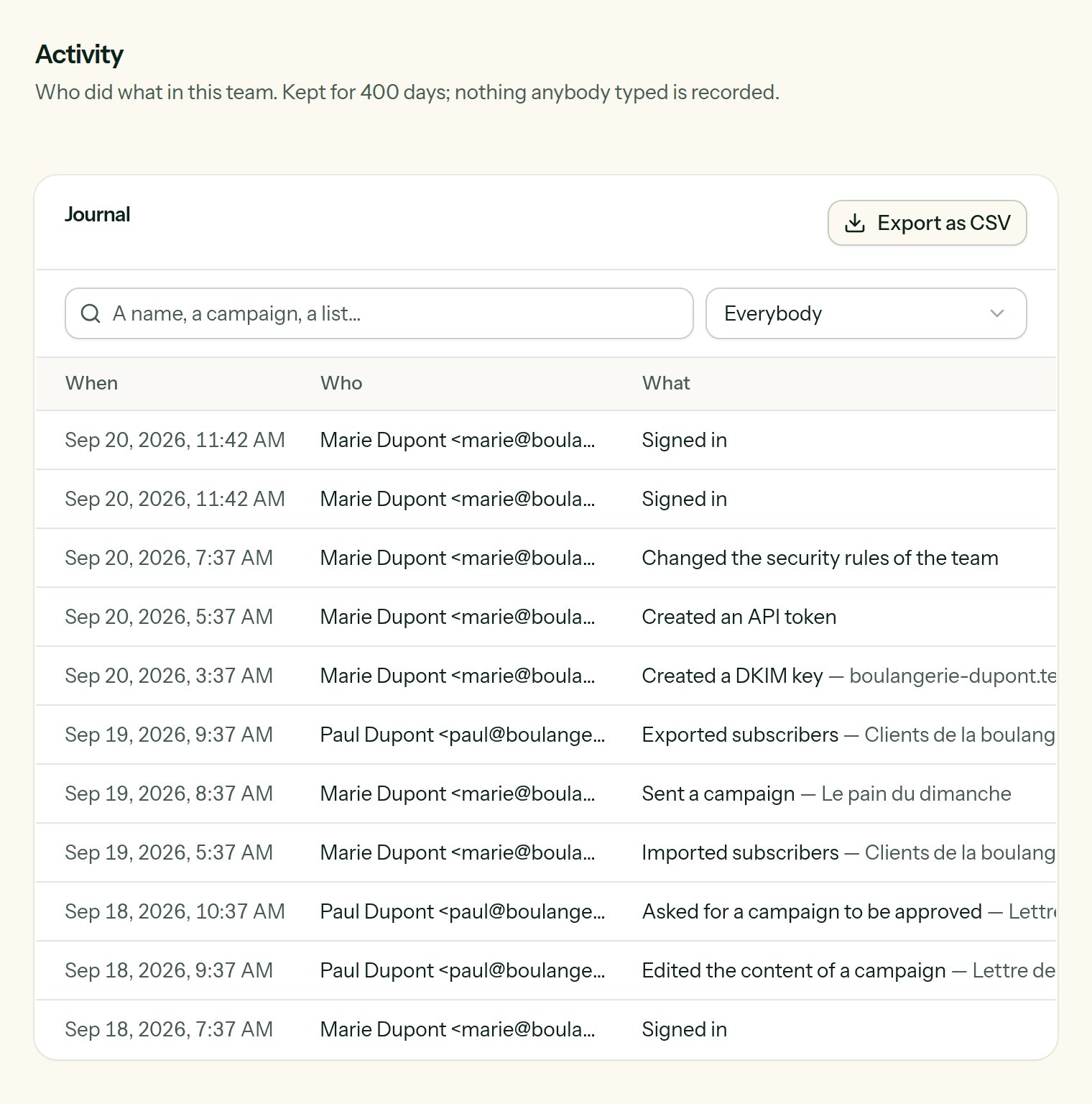
**Settings → Activity**, for the **owners** of the team. A journal of everything that changed something: a campaign sent, a list deleted, an export downloaded, a member invited, an API token created, a rule of the team switched.
 ## What a line says
| Column | Holds |
| -------- | ----------------------------------------------------------------------------------------------------------------------------------------------------------- |
| **When** | The moment, to the minute on screen; to the second in the CSV export. |
| **Who** | The member's name and address, kept in words: the line still means something once the account is gone. For an API call, the **token's name** and its owner. |
| **What** | The action, and what it was about: "Sent a campaign — Spring letter". |
| **From** | The IP address, and an **API** badge when a token did it. |
Search by a name, a campaign or a list; filter by member; **Export as CSV** takes out what the filters show.
## What is written down, and what is not
* **Every request that changed something and was not refused** — including, the day they exist, screens that do not exist yet: the journal does not depend on anybody remembering to add a line.
* **Downloads that take data out**: an export of subscribers, of the suppression list, of the journal itself.
* **Sign-ins.**
* **Nothing anybody typed.** Not the content of a campaign, not an address book, not a password: only what was done, to what, by whom, from where. Previews, checks and searches leave no line.
A request that was refused — a viewer clicking a button — leaves no line either: nothing happened.
## How long
Lines are kept **400 days**, then removed — thirteen months, enough to look at the same month of last year. A journal holds names and IP addresses; keeping it for ever would be a liability of its own. On a self-hosted installation the duration is a setting: see [Configuration](/self-hosting/configuration#data).
## What a line says
| Column | Holds |
| -------- | ----------------------------------------------------------------------------------------------------------------------------------------------------------- |
| **When** | The moment, to the minute on screen; to the second in the CSV export. |
| **Who** | The member's name and address, kept in words: the line still means something once the account is gone. For an API call, the **token's name** and its owner. |
| **What** | The action, and what it was about: "Sent a campaign — Spring letter". |
| **From** | The IP address, and an **API** badge when a token did it. |
Search by a name, a campaign or a list; filter by member; **Export as CSV** takes out what the filters show.
## What is written down, and what is not
* **Every request that changed something and was not refused** — including, the day they exist, screens that do not exist yet: the journal does not depend on anybody remembering to add a line.
* **Downloads that take data out**: an export of subscribers, of the suppression list, of the journal itself.
* **Sign-ins.**
* **Nothing anybody typed.** Not the content of a campaign, not an address book, not a password: only what was done, to what, by whom, from where. Previews, checks and searches leave no line.
A request that was refused — a viewer clicking a button — leaves no line either: nothing happened.
## How long
Lines are kept **400 days**, then removed — thirteen months, enough to look at the same month of last year. A journal holds names and IP addresses; keeping it for ever would be a liability of its own. On a self-hosted installation the duration is a setting: see [Configuration](/self-hosting/configuration#data).